Project Overview
CLPD is a Chilean-peso stablecoin that won both the Jury Category and the Prize Pool at the 2024 BASE LatAm Hackathon. In a four-week sprint I led brand, high-fidelity prototyping, and the full design system — making blockchain payments feel as familiar as a banking app for everyday Chileans, while handing engineering a drop-in component library aligned to their exact stack.
The product is a digital token pegged one-to-one to the Chilean peso (CLP) on the BASE blockchain, built to address a concrete local pain point: excessive government tracking and restriction of private financial transactions. The design challenge was bridging complex Web3 mechanics and ordinary citizens — a tool for financial freedom that feels stable, secure, and unremarkable to use.
The Challenge
- Cognitive overload: Web3 apps typically alienate ordinary citizens with steep learning curves and technical jargon.
- Aggressive timeline: Designed and shipped inside a strict hackathon window, demanding hyper-efficient workflows and immediate developer handoff.
- Trust and adoption: The interface had to earn instant trust for fiat-to-crypto conversions while still standing out to a Web3-native jury.
How I Solved It
1. Progressive Disclosure — one primary action per screen
To make blockchain mechanics feel like standard fiat transactions, I simplified the flow to a strict "one primary action per screen" philosophy. By separating steps and eliminating unnecessary fields, the interface actively guides the user — removing the friction and anxiety usually attached to crypto deposits, withdrawals, and liquidity investments.
2. "Simple Maximalism" — a vintage UI as a trust device
The visual identity leans into a vintage UI aesthetic, and the choice does double duty:
- Familiarity and trust: it grounds the app in established, highly recognizable interface patterns that feel stable and reliable to the everyday Chilean user.
- Web3 appeal: it taps current Web3 design trends, so the product stood out visually to the hackathon jury while staying accessible.
Engineering Handoff
Given the deadline, the methodology prioritized a flow that was simple to navigate for the user and simple to build for engineering.
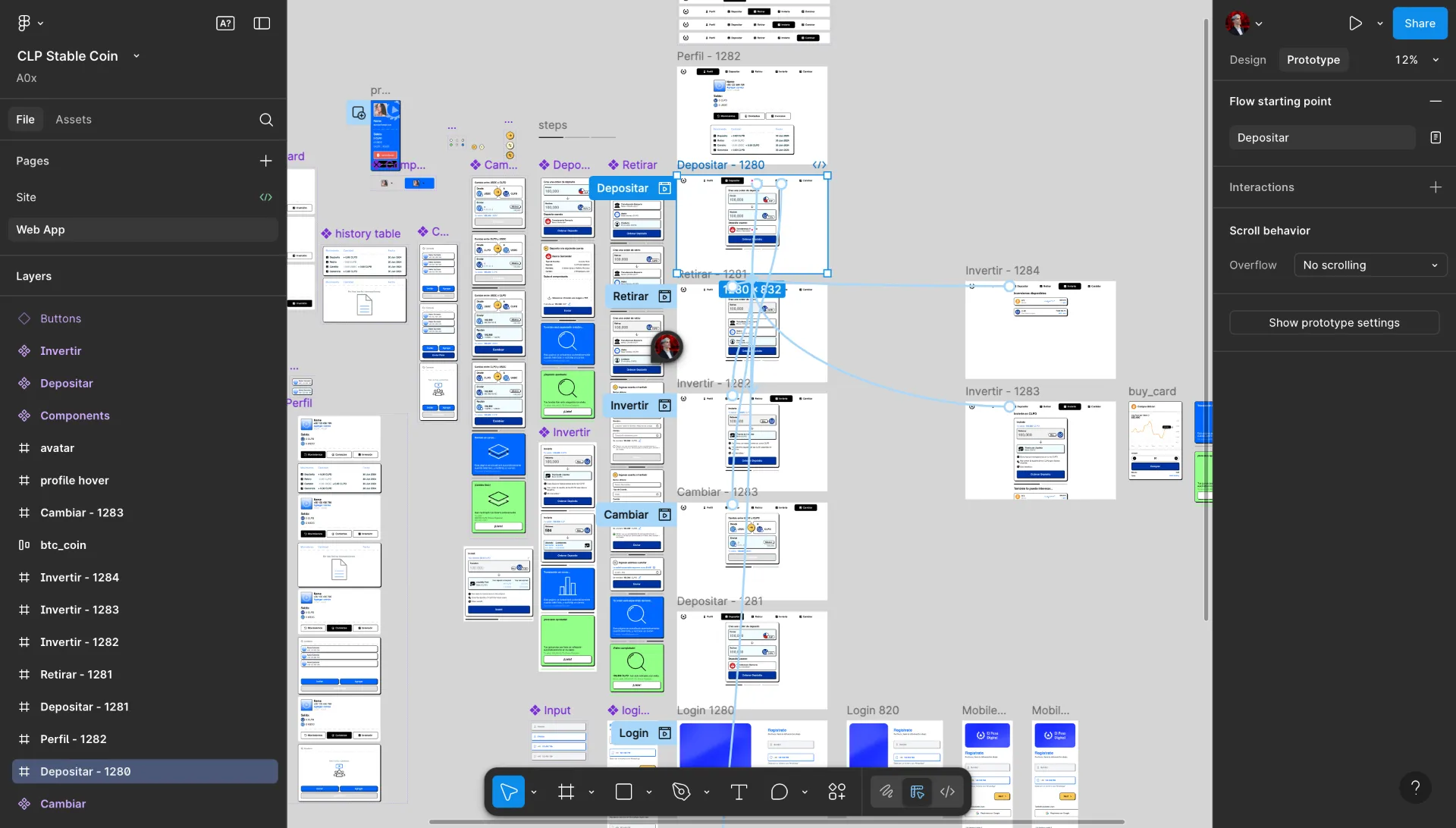
I built the Figma design system to mirror the exact screen flows, with modular, drop-in-ready components aligned to a modern frontend stack:
- UI foundation: Radix UI and Lucide Icons.
- Styling: Tailwind CSS syntax and mental models mapped directly from Figma.
- Web3 integration constraints: design decisions actively accommodated the technical limits imposed by the
uniswap-sdk,wagmi, andweb3authlibraries.
Outcome & Proof
CLPD won both the Jury Category and the Prize Pool at the 2024 BASE LatAm Hackathon — the two top honors of the event, awarded to a single project. The win validated the core bet: that user-centric UX and an engineering-ready handoff aren't a tradeoff, and that pairing them is what let a fiat-familiar interface land with a Web3-native jury inside a four-week window.
What this demonstrates: taking a product from brand and design system to a working, award-winning prototype under hackathon pressure — with a handoff engineering could build against immediately.